Tell buyers what to expect, week by week
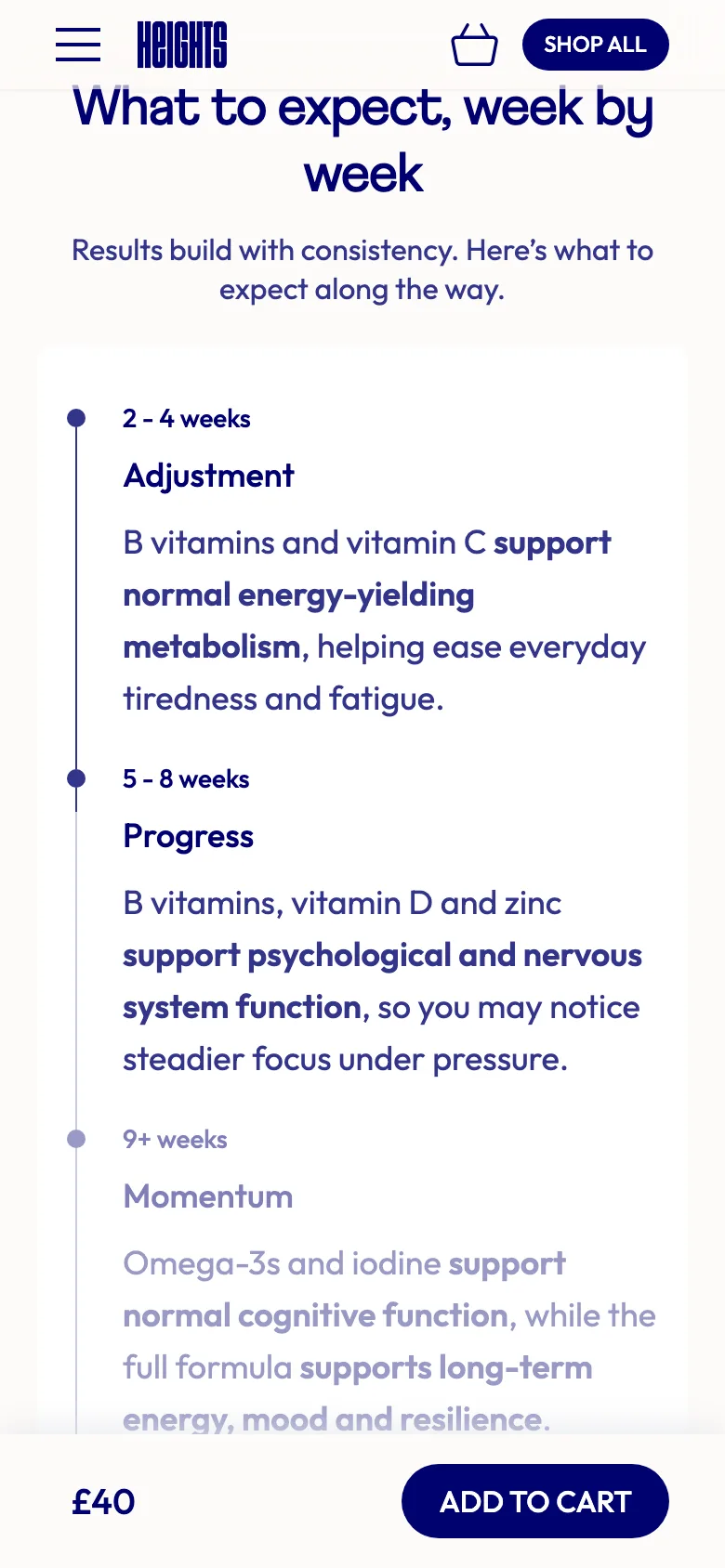
A vertical rail splits the first months into stages (2 to 4 weeks, 5 to 8 weeks, 9+ weeks), each with a name and what the buyer may notice.
What it is
Under the heading "What to expect, week by week" and the line "Results build with consistency", a vertical rail with dots marks three stages: 2 to 4 weeks (Adjustment), 5 to 8 weeks (Progress) and 9+ weeks (Momentum). Each stage names which nutrients are doing the work and what the buyer may notice.
Why it works
The real objection to a slow product is not "does it work" but "how will I know it is working before I give up". A dated rail sets the expectation up front, so week two without a miracle reads as on schedule rather than as failure, which protects both the first purchase and the second.
How to test it
- Hypothesis
- Adding a week-by-week expectation rail will lift subscription retention past the second order by setting realistic expectations before purchase.
- Primary metric
- Second-order retention rate
- Guardrail metric
- Product page conversion rate, to confirm stating a timeline does not deter first purchase
Related ideas
Want this tested on your store?
We run the experiment, call the result honestly, and get paid on what it adds.
See the performance program